Tangent line and rate of change
A tangent line touches a curve exactly once.
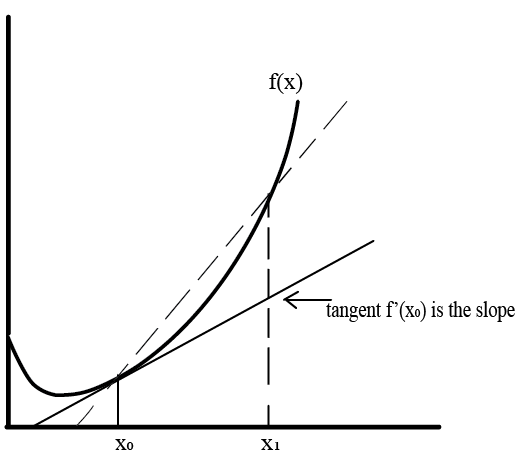
How can we estimate the slope of the line at ? First, evaluate . Then, evaluate at another point nearby. The slope is:
If we make very close to , we will get the slope of the tangent line. This suggests uses of a limit! We call the slope of the tangent to f at the derivative of f.
The derivative represents how fast the function is changing (rate of change). This is especially useful in physics when the function represents a coordinate, and the independent variable is time.
Example: Ball moving with constant velocity
A ball has position coordinate x and is moving with constant velocity v, so
where is the initial position that it starts from.
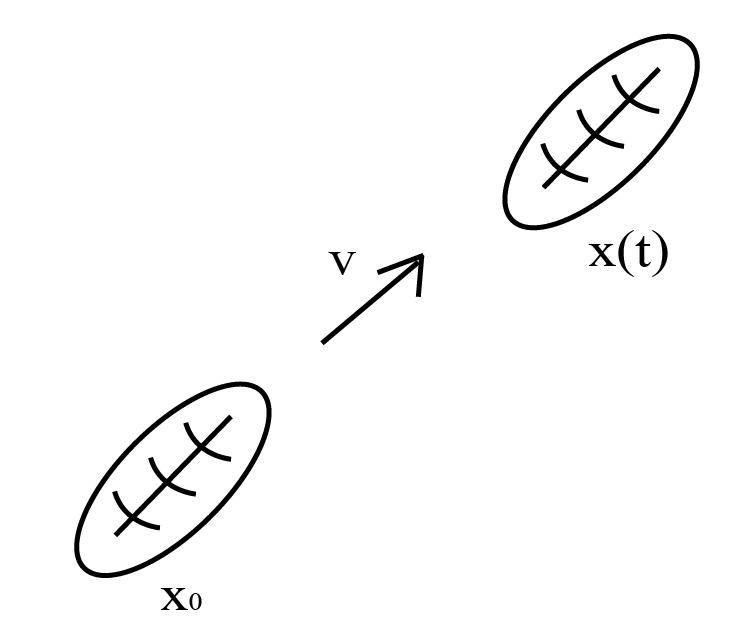
Show that the first derivative of the position x is the velocity v.
Formal definition
The derivative is also a function!
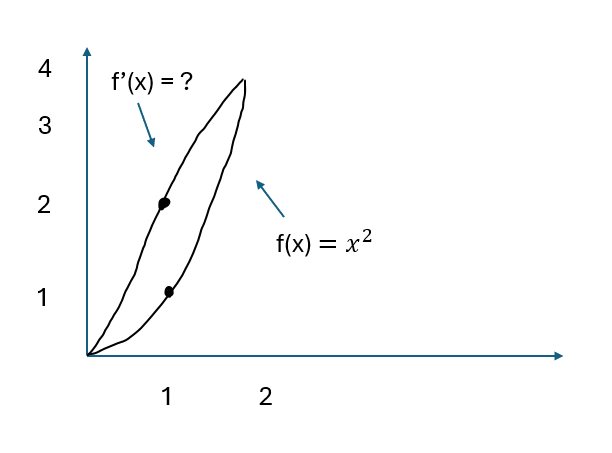
For example, if ,
This function represents how the slope of the line tangent to f is changing with x. For this function, the slope continually increases! Some additional examples:
Differentiability
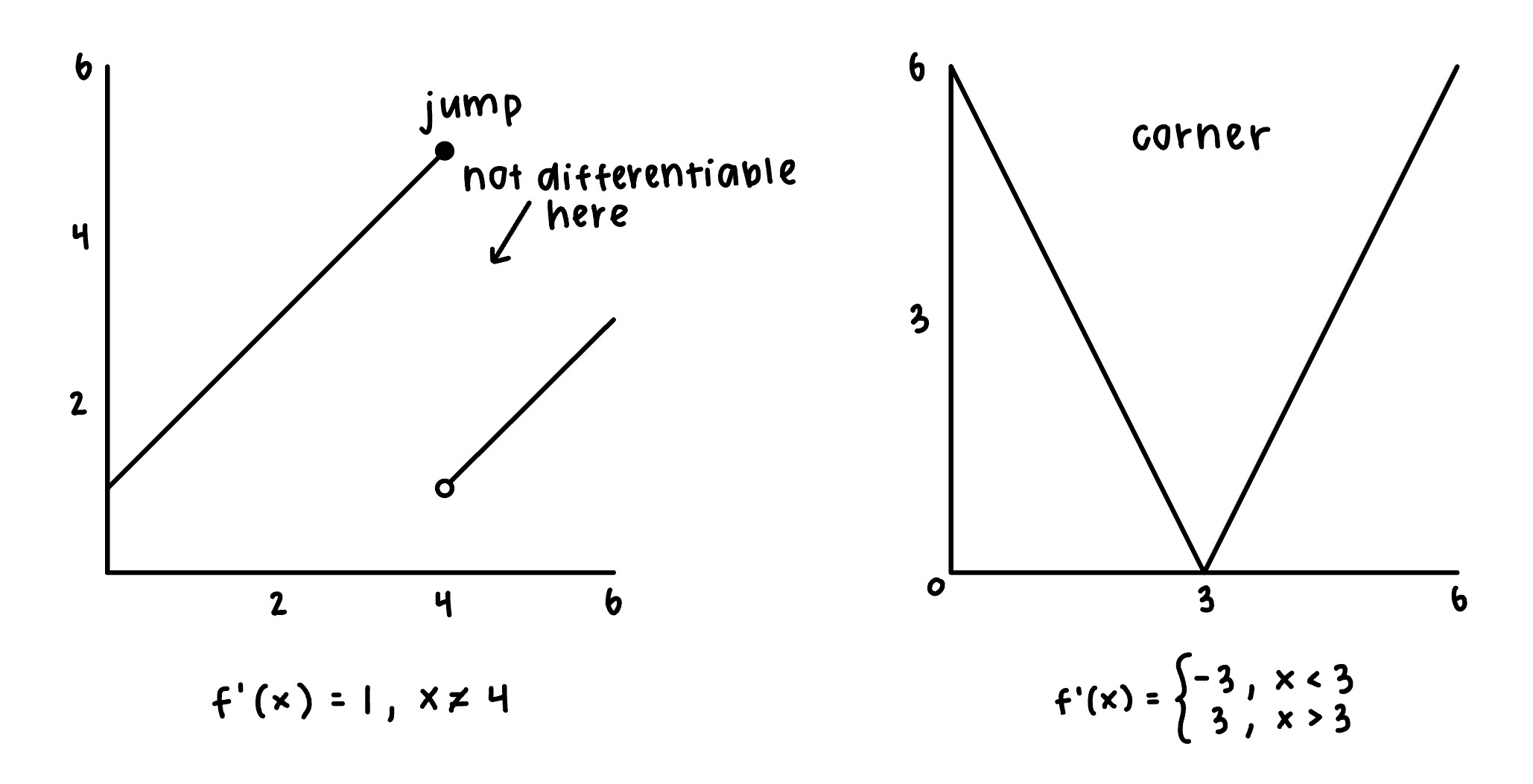
To be differentiable, this limit must exist. A function would not be differentiable at a jump, cusp, coner, or vertical tangent
Higher-order derivatives
We can try to take the derivative of any function, including the derivative itself! For example, consider , which has . We can evaluate the derivative of , which we will denote using the same formal definition:
We call the second derivative of f. Repeating the process we can obtain even higher-order derivatives. These may be denoted by additional primes (e.g., ), but often by a superscript (e.g., ) since it gets clunky to count too many primes.
Higher-order derivatives tell us about how lower-order derivatives are changing. For example, the second derivative tells us how the first derivative changes.
In a physical setting, we may have names for these different derivatives. For example, if we have the position x, the velocity v is the first derivative of x, while the acceleration a is the first derivative of v and second derivative of x.
| Position | Velocity | Acceleration |
|---|---|---|
| x | x’ | x’’ |
| v | v’ | |
| a |
Example: Ballistic motion
Consider the two-dimensional ballistic motion:
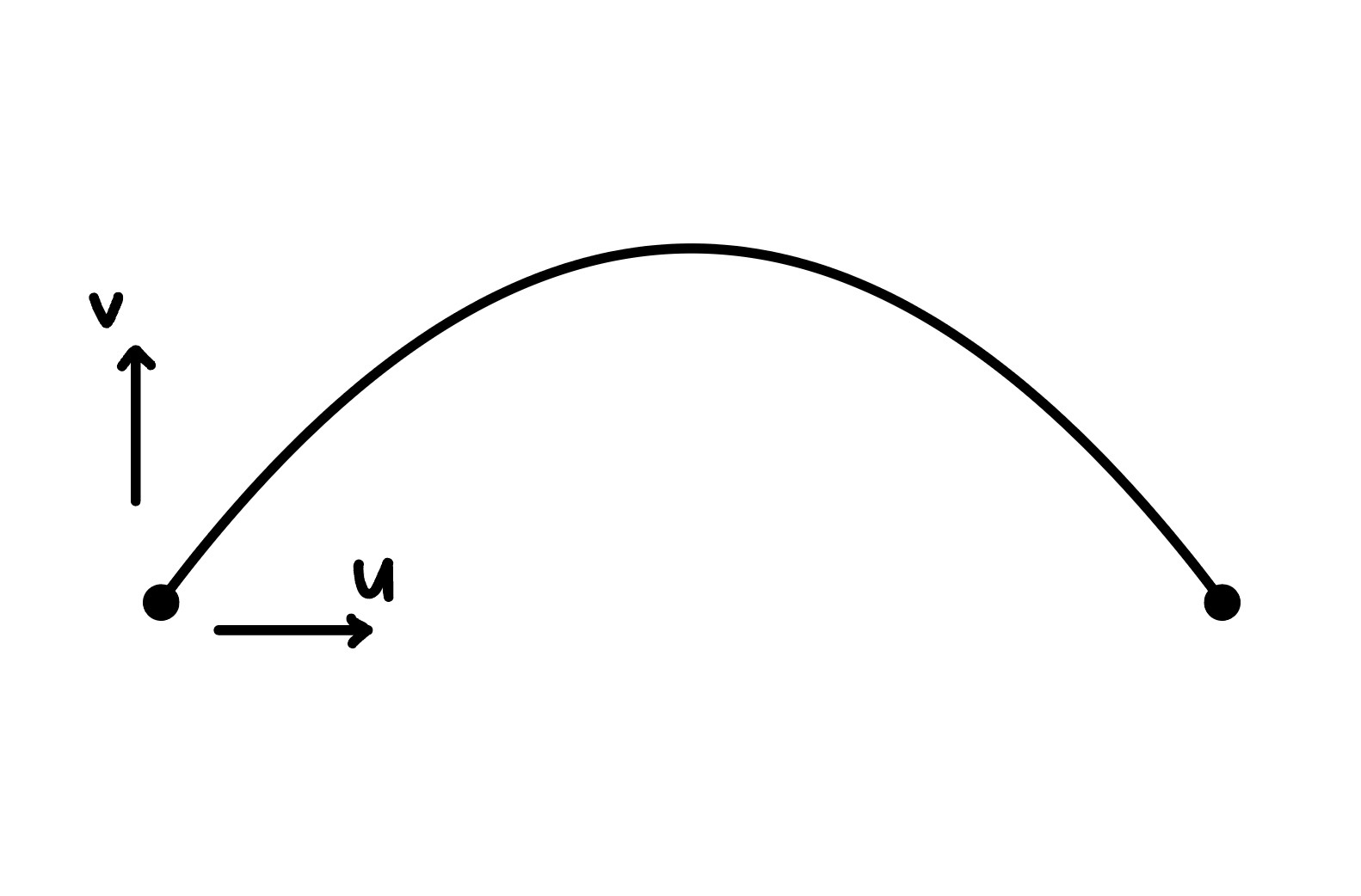
The equations of motion for the horizontal position x and vertical position y are:
where and are the initial x and y components of the velocity, and g is the acceleration due to gravity. Find the velocity and acceleration in x and y.
In the x direction, call the velocity u. Then,
Since u is a constant, the first derivative of u (second derivative of x) must be zero, and there is no acceleration in the x direction.
In the y direction, call the velocity v. Then,
The velocity in y is constantly increasing from the constant acceleration a due to gravity. This makes sense from what we know from physics!