1.5 Rules for derivatives
Some useful rules for derivatives to apply are:
Rule f ( x ) f(x) f ( x ) f ′ ( x ) f'(x) f ′ ( x ) Constant k k k 0 Power x n x^n x n n ≠ 0 n \ne 0 n = 0 n x n − 1 nx^{n-1} n x n − 1 Multiple k u ( x ) k u(x) k u ( x ) k u ′ ( x ) k u'(x) k u ′ ( x ) Sum u ( x ) + v ( x ) u(x) + v(x) u ( x ) + v ( x ) u ′ ( x ) + v ′ ( x ) u'(x) + v'(x) u ′ ( x ) + v ′ ( x ) Difference u ( x ) − v ( x ) u(x) - v(x) u ( x ) − v ( x ) u ′ ( x ) − v ′ ( x ) u'(x) - v'(x) u ′ ( x ) − v ′ ( x ) Exponential a x a^x a x a x ln a a^x \ln a a x ln a Logarithm log a x \log_a x log a x 1 x ln a \dfrac{1}{x \ln a} x ln a 1
Note that two special cases of the last two derivatives occur when a = e a = e a = e
d e x d x = e x d ln x d x = 1 x \dd{}{e^x}{x} = e^x \qquad \dd{}{\ln x}{x} = \frac{1}{x} d x d e x = e x d x d ln x = x 1 Here are some examples showing how to explicitly apply them:
f ′ ( x ) = 3 x 3 − 1 = 3 x 2 f'(x) = 3x^{3-1} = 3x^2 f ′ ( x ) = 3 x 3 − 1 = 3 x 2 f ′ ( x ) = d d x ( − x 2 ) + d d x ( 3 ) = − d d x ( x 2 ) + d d x ( 3 ) = − 2 x 2 − 1 + 0 = − 2 x \begin{align}
f'(x) &= \frac{d}{dx}(-x^2) + \frac{d}{dx}(3) \\
&= -\frac{d}{dx}(x^2) + \frac{d}{dx}(3) \\
&= -2x^{2-1} + 0 \\
&= -2x
\end{align} f ′ ( x ) = d x d ( − x 2 ) + d x d ( 3 ) = − d x d ( x 2 ) + d x d ( 3 ) = − 2 x 2 − 1 + 0 = − 2 x f ′ ( x ) = 4 3 d d x ( x 3 ) − d d x ( x ) + 2 d d x ( e x ) = 4 3 ( 3 x 2 ) − 1 + 2 e x = 4 x 2 − 1 + 2 e x \begin{align}
f'(x) &= \frac{4}{3} \frac{d}{dx}(x^3) - \frac{d}{dx}(x) +
2 \frac{d}{dx}(e^x) \\
&= \frac{4}{3}(3x^2) - 1 + 2e^x \\
&= 4x^2 - 1 + 2e^x
\end{align} f ′ ( x ) = 3 4 d x d ( x 3 ) − d x d ( x ) + 2 d x d ( e x ) = 3 4 ( 3 x 2 ) − 1 + 2 e x = 4 x 2 − 1 + 2 e x f ′ ( x ) = 3 d d x ( x − 2 ) + d d x ( x 1 / 2 ) = 3 ( − 2 x − 3 ) + 1 2 x − 1 / 2 = − 6 x 3 + 1 2 x \begin{align}
f'(x) &= 3 \frac{d}{dx}(x^{-2}) + \frac{d}{dx}(x^{1/2}) \\
&= 3(-2x^{-3}) + \frac{1}{2} x^{-1/2} \\
&= \frac{-6}{x^3} + \frac{1}{2\sqrt{x}}
\end{align} f ′ ( x ) = 3 d x d ( x − 2 ) + d x d ( x 1/2 ) = 3 ( − 2 x − 3 ) + 2 1 x − 1/2 = x 3 − 6 + 2 x 1 f ′ ( x ) = d d x [ log 4 + log x ] = d d x ( log 4 ) + d d x ( log x ) = 0 + 1 x ln 10 \begin{align}
f'(x) &= \frac{d}{dx} [\log 4 + \log x] \\
&= \frac{d}{dx}(\log 4) + \frac{d}{dx}(\log x) \\
&= 0 + \frac{1}{x \ln 10}
\end{align} f ′ ( x ) = d x d [ log 4 + log x ] = d x d ( log 4 ) + d x d ( log x ) = 0 + x ln 10 1 There are other rules related to functions that are products, quotients,
compositions, or trigonometric. We will go over each of those in more detail
next.
Product rule ¶ The product rule is used to differentiate functions that can be written as the
product of two smaller functions.
To demonstrate this rule, consider f ( x ) = ( x − 3 ) ( x − 1 ) f(x) = (x-3)(x-1) f ( x ) = ( x − 3 ) ( x − 1 )
f ( x ) = x 2 − 4 x + 3 f ′ ( x ) = 2 x − 4 \begin{align}
f(x) &= x^2 - 4x + 3 \\
f'(x) &= 2x - 4
\end{align} f ( x ) f ′ ( x ) = x 2 − 4 x + 3 = 2 x − 4 With the product rule, instead we recognize
u = x − 3 v = x − 1 u ′ = 1 v ′ = 1 \begin{align}
u &= x-3 & v &= x-1 \\
u' &= 1 & v' &= 1
\end{align} u u ′ = x − 3 = 1 v v ′ = x − 1 = 1 so
f ′ ( x ) = u v ′ + v u ′ = ( x − 3 ) ⋅ 1 + ( x − 1 ) ⋅ 1 = 2 x − 4 f'(x) = uv' + vu' = (x-3) \cdot 1 + (x-1) \cdot 1 = 2x - 4 f ′ ( x ) = u v ′ + v u ′ = ( x − 3 ) ⋅ 1 + ( x − 1 ) ⋅ 1 = 2 x − 4 This example is a little silly, but the product rule is a life saver for
functions that are hard to expand! Here are some better examples:
Identify:
u = x + 1 v = ( 2 x 2 + 5 ) ( 5 x 3 − 4 ) u = x+1 \qquad v = (2x^2+5)(5x^3-4) u = x + 1 v = ( 2 x 2 + 5 ) ( 5 x 3 − 4 ) so
f ′ ( x ) = ( x + 1 ) v ′ + ( 2 x 2 + 3 ) ( 5 x 3 − 4 ) ( 1 ) f'(x) = (x+1)v' + (2x^2 +3)(5x^3-4)(1) f ′ ( x ) = ( x + 1 ) v ′ + ( 2 x 2 + 3 ) ( 5 x 3 − 4 ) ( 1 ) The derivative v ′ v' v ′
u = 2 x 2 + 5 v = 5 x 3 − 4 u ′ = 4 x v ′ = 15 x 2 \begin{align}
u &= 2x^2+5 & v &= 5x^3-4 \\
u' &= 4x & v' &= 15x^2
\end{align} u u ′ = 2 x 2 + 5 = 4 x v v ′ = 5 x 3 − 4 = 15 x 2 finally giving
f ′ ( x ) = ( x + 1 ) [ ( 2 x 2 + 3 ) ( 15 x 2 ) + ( 5 x 3 − 4 ) ( 4 x ) ] + ( 2 x 2 + 5 ) ( 5 x 3 − 4 ) \begin{align}
f'(x) &= (x+1)[(2x^2+3)(15x^2) + (5x^3-4)(4x)] \\
&+ (2x^2+5)(5x^3-4)
\end{align} f ′ ( x ) = ( x + 1 ) [( 2 x 2 + 3 ) ( 15 x 2 ) + ( 5 x 3 − 4 ) ( 4 x )] + ( 2 x 2 + 5 ) ( 5 x 3 − 4 ) Identify:
u = 1 x v = e x u ′ = − 1 x 2 v ′ = e x \begin{align}
u &= \frac{1}{x} & v &= e^x \\
u' &= -\frac{1}{x^2} & v' &= e^x
\end{align} u u ′ = x 1 = − x 2 1 v v ′ = e x = e x so
f ′ ( x ) = 1 x e x + e x ( − 1 x 2 ) = e x ( 1 x − 1 x 2 ) \begin{align}
f'(x) &= \frac{1}{x}e^x + e^x(-\frac{1}{x^2}) \\
&= e^x\left(\frac{1}{x} - \frac{1}{x^2}\right)
\end{align} f ′ ( x ) = x 1 e x + e x ( − x 2 1 ) = e x ( x 1 − x 2 1 ) Identify:
u = x 2 + 3 v = ln ( x ) u ′ = 2 x v ′ = 1 x \begin{align}
u &= x^2+3 & v &= \ln(x) \\
u' &= 2x & v' &= \frac{1}{x}
\end{align} u u ′ = x 2 + 3 = 2 x v v ′ = ln ( x ) = x 1 so
f ′ ( x ) = ( x 2 + 3 ) ⋅ 1 x + ( ln x ) ( 2 x ) = x 2 + 3 x + 2 x ln x \begin{align}
f'(x) &= (x^2+3)\cdot\frac{1}{x} + (\ln x)(2x) \\
&= \frac{x^2+3}{x} + 2x\ln x
\end{align} f ′ ( x ) = ( x 2 + 3 ) ⋅ x 1 + ( ln x ) ( 2 x ) = x x 2 + 3 + 2 x ln x Quotient Rule ¶ One mnemonic that may or may not help remember this:
If the quotient rule you wish to know, it’s “low-d-high less high-d-low”... then
draw the line and, down below, denominator squared will go.
To demonstrate this rule, consider f ( x ) = ( x − 1 ) / x f(x) = (x-1)/x f ( x ) = ( x − 1 ) / x
f ( x ) = 1 − 1 x f ′ ( x ) = 1 x 2 \begin{align}
f(x) &= 1 - \frac{1}{x} \\
f'(x) &= \frac{1}{x^2}
\end{align} f ( x ) f ′ ( x ) = 1 − x 1 = x 2 1 With the qoutient rule, instead we recognize
u = x − 1 v = x u ′ = 1 v ′ = 1 \begin{align}
u &= x - 1 & v &= x \\
u' &= 1 & v' &= 1
\end{align} u u ′ = x − 1 = 1 v v ′ = x = 1 so
f ′ = x ⋅ 1 − ( x − 1 ) ⋅ 1 x 2 = 1 x 2 f' = \frac{ x \cdot 1 - (x-1) \cdot 1}{x^2} = \frac{1}{x^2} f ′ = x 2 x ⋅ 1 − ( x − 1 ) ⋅ 1 = x 2 1 This was obviously harder than the old way, but there are other cases where it
is helpful to do the quotient rule! Here are some examples you can try:
u = x 2 − 1 v = x 4 + 2 u ′ = 2 x v ′ = 4 x 3 \begin{align}
u &= x^2 -1 & v &= x^4 +2 \\
u' &= 2x & v' &= 4x^3
\end{align} u u ′ = x 2 − 1 = 2 x v v ′ = x 4 + 2 = 4 x 3 so
f ′ ( x ) = ( x 4 + 2 ) ⋅ ( 2 x ) − ( x 2 − 1 ) ⋅ ( 4 x 3 ) ( x 4 + 2 ) 2 = 2 x 5 + 4 x 2 − 4 x 5 + 4 x 3 x 8 + 2 x 4 + 4 \begin{align}
f'(x) &= \frac{ (x^4 + 2) \cdot (2x) - (x^2 - 1) \cdot (4x^3)}{(x^4 +2)^2}\\
&= \frac{2x^5 + 4x^2 - 4x^5 +4x^3}{x^8 + 2x^4 + 4}
\end{align} f ′ ( x ) = ( x 4 + 2 ) 2 ( x 4 + 2 ) ⋅ ( 2 x ) − ( x 2 − 1 ) ⋅ ( 4 x 3 ) = x 8 + 2 x 4 + 4 2 x 5 + 4 x 2 − 4 x 5 + 4 x 3 u = e x v = 1 + x u ′ = e x v ′ = 1 \begin{align}
u &= e^{x} & v &= 1 + x \\
u' &= e^{x} & v' &= 1
\end{align} u u ′ = e x = e x v v ′ = 1 + x = 1 so
f ′ ( x ) = ( 1 + x ) ⋅ e x − e x ⋅ 1 ( 1 + x ) 2 = x e x ( 1 + x ) 2 \begin{align}
f'(x) &= \frac{(1 + x) \cdot e^{x} - e^{x} \cdot 1}{(1 + x)^2} \\
&= \frac{x e^{x}}{(1 + x)^2}
\end{align} f ′ ( x ) = ( 1 + x ) 2 ( 1 + x ) ⋅ e x − e x ⋅ 1 = ( 1 + x ) 2 x e x u = v = x 4 u ′ = 3 x 2 − 6 x + 2 v ′ = 4 x 3 \begin{align}
u &= & v &= x^4\\
u' &= 3x^2 - 6x + 2 & v' &= 4x^3 \\
\end{align} u u ′ = = 3 x 2 − 6 x + 2 v v ′ = x 4 = 4 x 3 so
f ′ ( x ) = x 4 ⋅ ( 3 x 2 − 6 x + 2 ) − ( x 3 − 3 x 2 + 2 x ) ⋅ 4 x 3 x 8 = − x 6 + 6 x 5 − 6 x 4 x 8 = − 1 x 2 + 6 x 3 − 6 x 4 \begin{align}
f'(x) &= \frac{x^4 \cdot (3x^2-6x+2) - (x^3 -3x^2 +2x) \cdot 4x^3}{x^8} \\
&= \frac{-x^6 + 6x^5 - 6x^4}{x^8} \\
&= -\frac{1}{x^2} + \frac{6}{x^3} - \frac{6}{x^4}
\end{align} f ′ ( x ) = x 8 x 4 ⋅ ( 3 x 2 − 6 x + 2 ) − ( x 3 − 3 x 2 + 2 x ) ⋅ 4 x 3 = x 8 − x 6 + 6 x 5 − 6 x 4 = − x 2 1 + x 3 6 − x 4 6 Note, though, that in this case we could also have expanded the numerator,
divided through by x 8 x^8 x 8
Chain rule ¶ The chain rule is used to differentiate composite functions, when the “inside”
of the function is more complicated than what we know.
To demonstrate this rule, consider f ( x ) = ( x − 1 ) 2 f(x) = (x-1)^2 f ( x ) = ( x − 1 ) 2
f ( x ) = x 2 − 2 x + 1 f ′ ( x ) = 2 x − 2 \begin{align}
f(x) &= x^2 - 2x + 1 \\
f'(x) &= 2x - 2
\end{align} f ( x ) f ′ ( x ) = x 2 − 2 x + 1 = 2 x − 2 With the chain rule, instead we recognize
u = x − 1 f = u 2 u ′ = 1 f ′ = 2 u \begin{align}
u &= x - 1 & f &= u^2 \\
u' &= 1 & f' &= 2u
\end{align} u u ′ = x − 1 = 1 f f ′ = u 2 = 2 u so
f ′ ( x ) = d f d u d u d x = 2 u d u d x = 2 ( x − 1 ) ⋅ 1 = 2 x − 2 f'(x) = \dd{}{f}{u} \dd{}{u}{x} = 2u \dd{}{u}{x} = 2(x-1) \cdot 1 = 2x - 2 f ′ ( x ) = d u d f d x d u = 2 u d x d u = 2 ( x − 1 ) ⋅ 1 = 2 x − 2 The results match! Some additional examples:
Make the replacement u = x 2 u = x^2 u = x 2
u = x 2 f = e u u ′ = 2 x f ′ = e u \begin{align}
u &= x^2 & f &= e^u \\
u' &= 2x & f' &= e^u
\end{align} u u ′ = x 2 = 2 x f f ′ = e u = e u so
f ′ ( x ) = d f d u d u d x = e u d u d x = e x 2 ⋅ 2 x f'(x) = \dd{}{f}{u} \dd{}{u}{x} = e^{u} \dd{}{u}{x} = e^{x^2} \cdot 2x f ′ ( x ) = d u d f d x d u = e u d x d u = e x 2 ⋅ 2 x Make the replacement u = 1 + 2 x u = 1+2x u = 1 + 2 x
u = 1 + 2 x f = ln u u ′ = 2 f ′ = 1 u \begin{align}
u &= 1 + 2x & f &= \ln u \\
u' &= 2 & f' &= \frac{1}{u}
\end{align} u u ′ = 1 + 2 x = 2 f f ′ = ln u = u 1 so
f ′ ( x ) = d f d u d u d x = 1 u d u d x = 2 1 + 2 x f'(x) = \dd{}{f}{u} \dd{}{u}{x} = \frac{1}{u} \dd{}{u}{x} = \frac{2}{1 + 2x} f ′ ( x ) = d u d f d x d u = u 1 d x d u = 1 + 2 x 2 Make the replacement u = 1 + 2 x u = 1+2x u = 1 + 2 x
u = 1 + 2 x f = 2 u − 1 u ′ = 2 f ′ = − 2 u − 2 \begin{align}
u &= 1 + 2x & f &= 2u^{-1} \\
u' &= 2 & f' &= -2u^{-2}
\end{align} u u ′ = 1 + 2 x = 2 f f ′ = 2 u − 1 = − 2 u − 2 so
f ′ ( x ) = d f d u d u d x = − 2 u − 2 ⋅ d u d x = − 4 ( 1 + 2 x ) 2 f'(x) = \dd{}{f}{u} \dd{}{u}{x} = -2u^{-2} \cdot \dd{}{u}{x} =
\frac{-4}{(1 + 2x)^2} f ′ ( x ) = d u d f d x d u = − 2 u − 2 ⋅ d x d u = ( 1 + 2 x ) 2 − 4 Trigonometric functions ¶ f ( x ) f(x) f ( x ) f ′ ( x ) f'(x) f ′ ( x ) f ( x ) f(x) f ( x ) f ′ ( x ) f'(x) f ′ ( x ) sin x \sin x sin x cos x \cos x cos x csc x \csc x csc x − csc x cot x -\csc x \cot x − csc x cot x cos x \cos x cos x − sin x -\sin x − sin x sec ( x ) \sec(x) sec ( x ) sec x tan x \sec x \tan x sec x tan x tan x \tan x tan x sec 2 x \sec^2 x sec 2 x cot x \cot x cot x − csc 2 x -\csc^2 x − csc 2 x
All of these follow from knowing only two derivatives: sin x \sin x sin x cos x \cos x cos x tan x \tan x tan x
f ( x ) = tan x = sin x cos x f ′ ( x ) = cos x ⋅ cos x − sin x ⋅ ( − sin x ) cos 2 x = sin 2 x + cos 2 x cos 2 x = 1 cos 2 x = sec 2 x \begin{align}
f(x) &= \tan x = \frac{\sin x}{\cos x} \\
f'(x) &= \frac{\cos x \cdot \cos x - \sin x \cdot (-\sin x)}{\cos^2 x} \\
&= \frac{\sin^2 x + \cos^2 x}{\cos^2 x}\\
&= \frac{1}{\cos^2 x} \\
&= \sec^2 x
\end{align} f ( x ) f ′ ( x ) = tan x = cos x sin x = cos 2 x cos x ⋅ cos x − sin x ⋅ ( − sin x ) = cos 2 x sin 2 x + cos 2 x = cos 2 x 1 = sec 2 x Or, to find the derivative of csc x \csc x csc x
f ( x ) = csc x = ( sin x ) − 1 f ′ ( x ) = − ( sin x ) − 2 d d x ( sin x ) = ( sin x ) − 2 ⋅ ( − cos x ) = − 1 sin x cos x sin x = − csc x cot x \begin{align}
f(x) &= \csc x = (\sin x)^{-1} \\
f'(x) &= -(\sin x)^{-2} \dd{}{}{x}(\sin x) \\
&= (\sin x)^{-2} \cdot (-\cos x) \\
&= \frac{-1}{\sin x} \frac{\cos x}{\sin x} \\
&= -\csc x \cot x
\end{align} f ( x ) f ′ ( x ) = csc x = ( sin x ) − 1 = − ( sin x ) − 2 d x d ( sin x ) = ( sin x ) − 2 ⋅ ( − cos x ) = sin x − 1 sin x cos x = − csc x cot x Some additional examples to practice:
f ′ = 3 d d x ( cos x ) + 4 d d x ( sin x ) = − 3 sin x + 4 cos x \begin{align}
f' &= 3 \dd{}{}{x}(\cos x) + 4 \dd{}{}{x}(\sin x)\\
&= -3\sin x + 4\cos x
\end{align} f ′ = 3 d x d ( cos x ) + 4 d x d ( sin x ) = − 3 sin x + 4 cos x Use the product rule with:
u = sin x v = cos x u ′ = cos x v ′ = − sin x \begin{align}
u &= \sin x & v &= \cos x\\
u' &= \cos x & v' &= -\sin x
\end{align} u u ′ = sin x = cos x v v ′ = cos x = − sin x so
f ′ = 2 [ sin x ( − sin x ) + cos x ( cos x ) ] = 2 ( cos 2 x − sin 2 x ) = 2 cos 2 x \begin{align}
f' &= 2[\sin x(-\sin x) + \cos x(\cos x)] \\
&= 2(\cos^2 x-\sin^2 x) \\
&= 2 \cos 2x\\
\end{align} f ′ = 2 [ sin x ( − sin x ) + cos x ( cos x )] = 2 ( cos 2 x − sin 2 x ) = 2 cos 2 x Use the chain rule with
u = 2 x f = sin u u ′ = 2 f ′ = cos u \begin{align}
u &= 2x & f &= \sin u \\
u' &= 2 & f' = \cos u
\end{align} u u ′ = 2 x = 2 f f ′ = cos u = sin u so
f ′ = cos u ⋅ 2 = 2 cos 2 x f' = \cos{u} \cdot 2 = 2 \cos 2 x f ′ = cos u ⋅ 2 = 2 cos 2 x Use the chain rule with
u = x 2 + 2 x + 3 f = tan u u ′ = 2 x + 2 f ′ = sec 2 u \begin{align}
u &= x^2+2x+3 & f = \tan u\\
u' &= 2x+2 & f' = \sec^2 u\\
\end{align} u u ′ = x 2 + 2 x + 3 = 2 x + 2 f = tan u f ′ = sec 2 u so
f ′ = sec 2 u ⋅ u ′ = ( 2 x + 2 ) sec 2 ( x 2 + 2 x + 3 ) \begin{align}
f' &= \sec^2 u \cdot u'\\
&= (2x+2)\sec^2(x^2+2x+3)\\
\end{align} f ′ = sec 2 u ⋅ u ′ = ( 2 x + 2 ) sec 2 ( x 2 + 2 x + 3 ) Use the chain rule with
u = cos 2 x f = e u u ′ = d d x ( cos 2 x ) f ′ = e u \begin{align}
u &= \cos^2 x & f = e^{u}\\
u' &= \dd{}{}{x}(\cos^2 x) & f' = e^{u}
\end{align} u u ′ = cos 2 x = d x d ( cos 2 x ) f = e u f ′ = e u So
f ′ = e u u ′ = e cos 2 x d d x ( cos 2 x ) f' = e^{u} u' = e^{\cos^2 x} \dd{}{}{x}(\cos^2 x) f ′ = e u u ′ = e c o s 2 x d x d ( cos 2 x ) Use the chain rule again with
u = cos x f = u 2 u ′ = − sin x f ′ = 2 u \begin{align}
u &= \cos x & f = u^{2}\\
u' &= -\sin x & f' = 2u\\
\end{align} u u ′ = cos x = − sin x f = u 2 f ′ = 2 u So
f ′ = e cos 2 x ( 2 u u ′ ) = e cos 2 x ( 2 cos x ⋅ − sin x ) = − 2 sin x cos x e cos 2 x \begin{align}
f' &= e^{\cos^2 x}(2uu')\\
&= e^{\cos^2 x}(2\cos x \cdot -\sin x)\\
&= -2 \sin x \cos x e^{\cos^2 x}\\
\end{align} f ′ = e c o s 2 x ( 2 u u ′ ) = e c o s 2 x ( 2 cos x ⋅ − sin x ) = − 2 sin x cos x e c o s 2 x Last, let’s look at a physics application of these techniques:
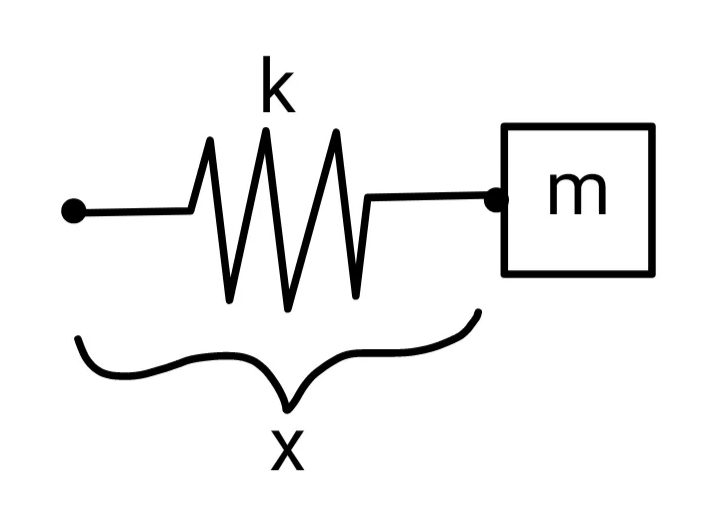
Example: Harmonic oscillator ¶ A harmonic oscillator is a mass m on a Hookean spring. The spring force is
F = − k x F = -kx F = − k x k is the spring constant and x is the displacement of the
mass.
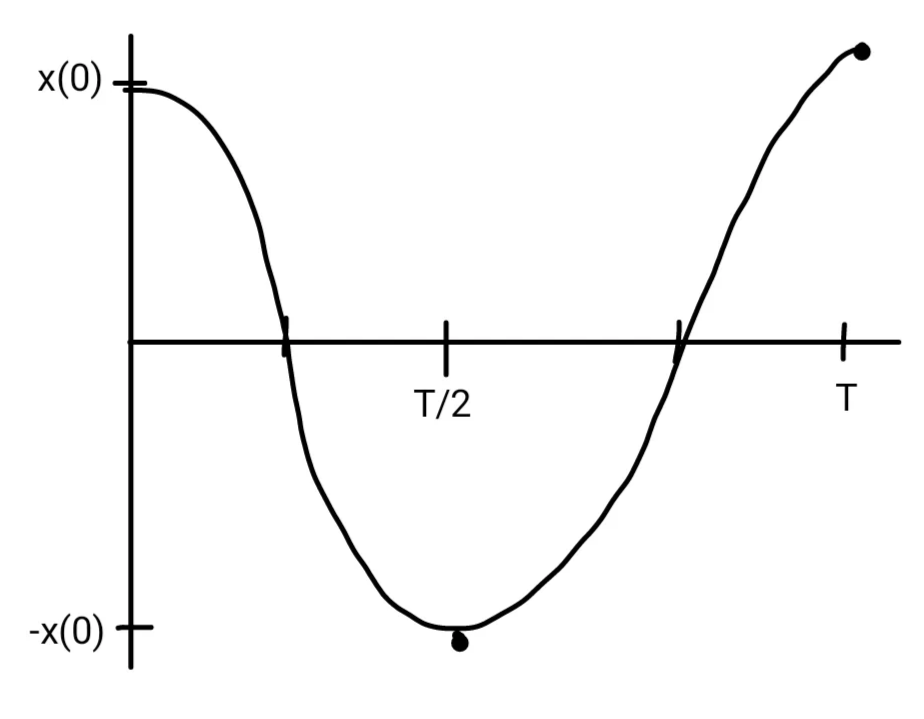
If the mass is initially displaced to x ( 0 ) x(0) x ( 0 )
x ( t ) = x ( 0 ) cos ( 2 π t T ) x(t) = x(0) \cos\left(\frac{2\pi t}{T}\right) x ( t ) = x ( 0 ) cos ( T 2 π t ) where
T = 1 2 π m k T = \frac{1}{2\pi} \sqrt{\frac{m}{k}} T = 2 π 1 k m How fast is the oscillator moving at any given time? When is the oscillator
moving fastest?
We want to calculate the velocity v = x ′ ( t ) v = x'(t) v = x ′ ( t )
u = 2 π t T f = x ( 0 ) cos u u ′ = 2 π T f ′ = − x ( 0 ) sin u \begin{align}
u &= \frac{2\pi t}{T} & f &= x(0) \cos u \\
u' &= \frac{2\pi}{T} & f' &= -x(0) \sin u
\end{align} u u ′ = T 2 π t = T 2 π f f ′ = x ( 0 ) cos u = − x ( 0 ) sin u so
v = d x d t = f ′ ( u ) ⋅ u ′ = − x ( 0 ) sin u ⋅ u ′ = − 2 π x ( 0 ) T sin ( 2 π t T ) \begin{align}
v &= \dd{}{x}{t} = f'(u) \cdot u' \\
&= -x(0) \sin u \cdot u' \\
&= -\frac{2\pi x(0)}{T} \sin\left(\frac{2\pi t}{T}\right)
\end{align} v = d t d x = f ′ ( u ) ⋅ u ′ = − x ( 0 ) sin u ⋅ u ′ = − T 2 π x ( 0 ) sin ( T 2 π t ) A function is at an extrema when its derivative is zero. If the function is
velocity, this derivative is the acceleration a and is equal to zero,
a = v ′ = 0 a = v' = 0 a = v ′ = 0
a = v ′ = − ( 2 π T ) 2 x ( 0 ) cos ( 2 π t T ) = 0 a = v' =
-\left(\frac{2\pi}{T}\right)^2 x(0) \cos\left(\frac{2\pi t}{T}\right) = 0 a = v ′ = − ( T 2 π ) 2 x ( 0 ) cos ( T 2 π t ) = 0 The roots occur at t = T / 4 t = T/4 t = T /4 3 T / 4 3T/4 3 T /4 x = 0 x = 0 x = 0