has n roots, which may be real or complex. Real roots may be distinct or
repeated. Complex roots always come in conjugate pairs, a±bi, where
a is called the real part, ±b is called the imaginary part, and
i=−1 is the imaginary unit.
Quadratic polynomials can have three types of roots:
Two real roots
One (repeated) root
Two complex roots
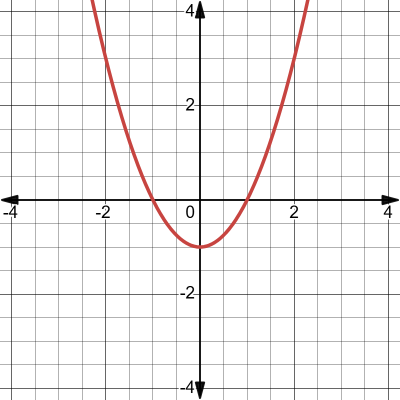
Graphically, two real roots occur as two intersections of a parabola with the
y-axis. For example, the roots of x2−1=0 occur at x=±1:
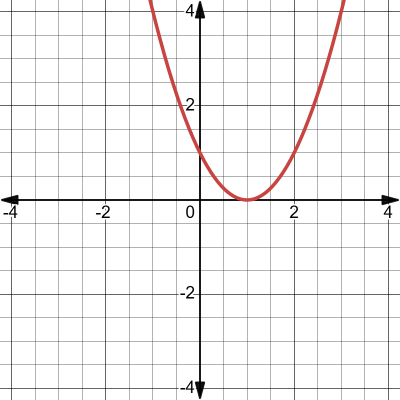
One repeated root occurs as a single point of a parabola (its minimum or
maximum) touching the y-axis. For example, the root of (x−1)2=0 occurs at
x=1:
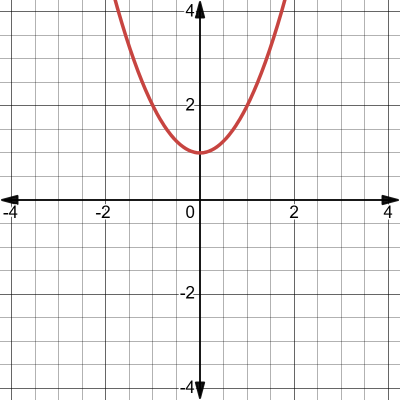
Complex roots do not appear as intersections on a graph. For example, the roots
of x2+1=0 are x=±i:
There are several strategies that can be used to find roots of quadratic
polynomials:
An open-top box will be made from an 8.5" x 11" piece of paper by cutting out a
square from each corner and folding the flaps. What size square should be cut
to make the biggest box?
The volume of the box that will be obtained by cutting a square of edge length
x is:
General formulas for roots of cubic and quartic polynomials are known but
complicated. No such formula exists for higher-order polynomials. In these
cases, numerical methods are needed!