An ordinary differential equation (ODE) contains one or more derivatives of an unknown function of one variable.
The order of an ODE is its highest derivative. First-order ODEs in implicit form look like:
and in explicit form look like:
When do we see first-order ODEs in chemical engineering?
Unsteady mass/energy balances
Chemical kinetics
Direction fields
ODEs have families of solutions due to integration constants. The direction field (or slope field) is obtained by plotting the slope at (x, y) from , and it shows how a point will evolve.
Example: Direction field
Given the first-order ODE
Draw the slope field, then verify that
is a general solution.
The direction field is
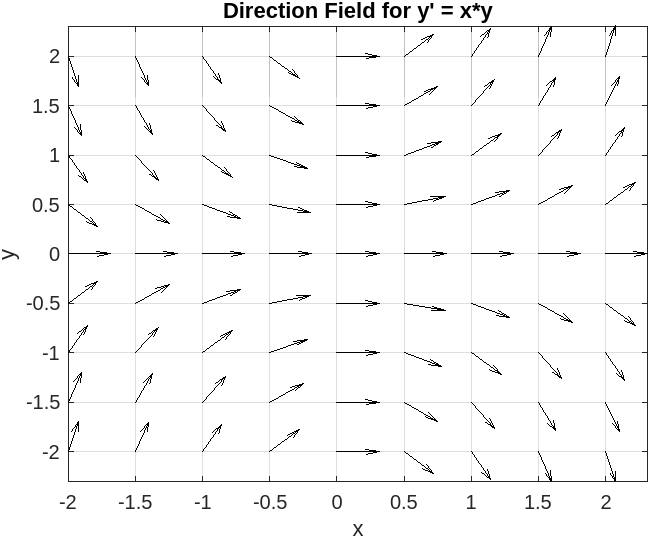
Now, let’s verify the proposed solution. The first derivative of y is
Substituting y and in the differential equation
shows this is indeed a solution.
Initial value problems
To obtain a specific solution, an initial condition specifying a point is needed. A first-order ODE with an initial condition is called an initial value problem.
Example: Initial value problem
For the first-order ODE above, find the solution when .
Substitute and into the general solution to determine :
This gives the solution